Home / Eggshell panels
Tranh khảm vỏ trứng
Eggshell-inlay panels, laid fragment by fragment
The whitest white in sơn mài comes not from paint but from crushed eggshell, pressed into wet lacquer and sanded flush.
Ready to hang
Two brass rings and a braided cord are fixed to the back. The panel lies close to the wall and needs one picture hook rated for a few kilos.
Size and price
| Piece | What you receive | Price (USD) |
|---|---|---|
| Eggshell panel, 40 × 40 cm | Square panel on a wooden board, black lacquer ground with an eggshell pattern; back finished and fitted for hanging. | $155 |
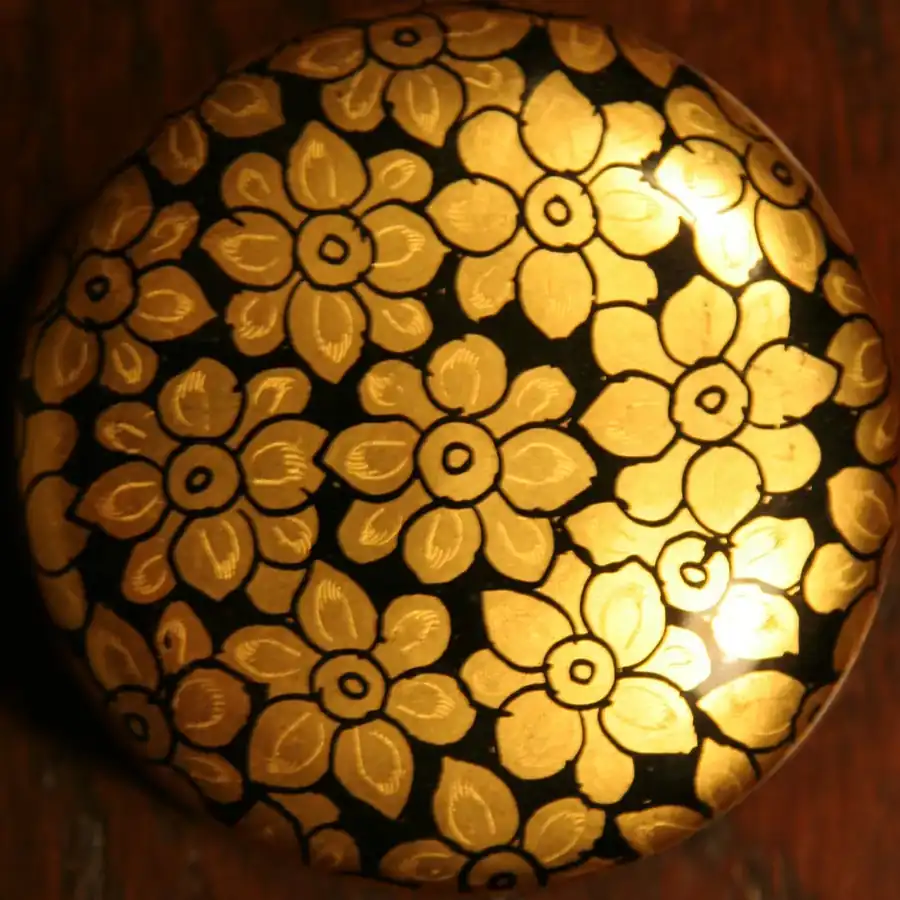
We make one panel size. It is square, 40 cm on each side, and shallow enough to sit flat against a wall like a framed print. The pattern varies with what we have finished — lotus, bamboo, a curve of river, or an abstract field of white — and we describe the panels in stock when we reply to your order.
How the shell is laid
- Preparing the shell. Eggshells are washed, the inner skin is peeled away, and the shells are dried. Some are toasted lightly to give warmer cream and brown tones beside the pure white.
- Laying it in. A section of the design is brushed with fresh lacquer. A piece of shell is pressed into it with the convex side up, then tapped with a fine tool so it cracks into a mosaic of tiny fragments that stay in place.
- Spacing. The fragments are nudged apart with a needle so a hairline of dark lacquer shows between them — that black web of lines is what gives eggshell inlay its crackle.
- Burying. Once the shell has set, coats of lacquer go over the whole panel, covering shell and ground alike.
- Sanding flush. The panel is wet-sanded until the white comes back through, perfectly level with the black around it.
- Polishing. Fine powder and the palm of the hand bring the surface to a deep, even gloss.
Because the white is shell and not pigment, it does not yellow the way white paint can, and because it is sanded level, the surface is smooth to the fingertips even though the pattern looks cracked.
Hanging and placing
Hang the panel on an inside wall, away from radiators, fireplaces and the strong afternoon sun of a south-facing window. Bathrooms and kitchens are not good places: steam and grease dull the surface. Hold it by the edges with dry hands, dust it with a soft brush or dry cloth, and never spray cleaner on it. If you move house, wrap it face-in in a soft cloth before it goes in a box.
What we will not do
We do not make panels to custom dimensions or to a design you send, and we do not sell old or antique panels. Every panel is new, square, 40 × 40 cm, finished in our shop, and priced at $155.
Shipping a panel safely
A panel travels face-in against a sheet of soft foam, between two rigid boards, inside a padded outer box. The delivery rate is the same as for any other piece; our delivery page lists the costs by region. If the corner of a panel arrives chipped, write to us within seven days with photographs and we put it right as described on the returns page.